
SRHS student shoots for the stars
By Ashley Shah
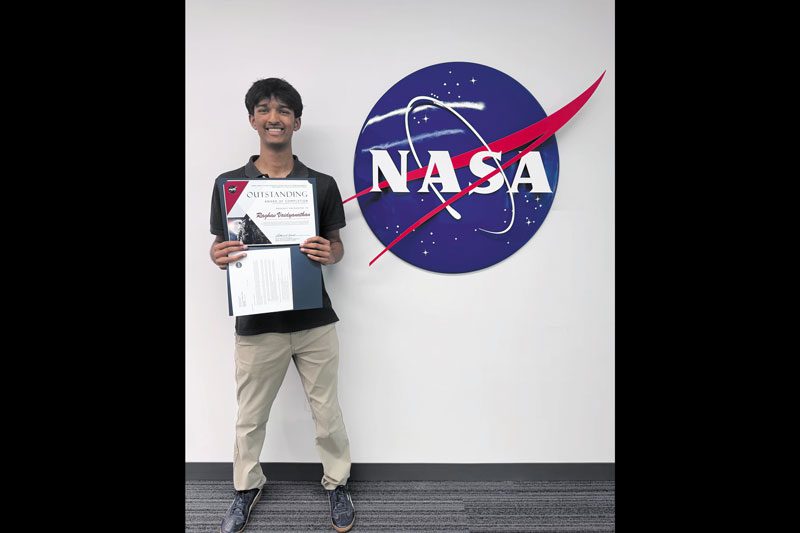
Raghav Vaidyanathan, a senior at Scripps Ranch High School (SRHS), participated in NASA’s Student Launch Initiative this past year.
“I was recruited by our coach, John Pacente, to join Team Hydra last summer,” Vaidyanathan said. “Our team consisted of 13 high schoolers from schools in San Diego and Orange County.”
NASA’s Student Launch Initiative, sponsored by Northrop Grumman, consists of teams of about 10 to 15 students who build a nine foot rocket with a payload that will be launched to 3,000 to 6,000 feet.
The national competition took place in Huntsville, Alabama, in April of this year. There were no specific recognitions or awards given at the competition.
There were around 60 teams, 10 of which were youth/high school teams.
“The competition is mainly geared toward teams in college, but we were one of the only teams there that had members in the high school/youth team (category),” Vaidyanathan said.
There were four components to building the rocket: avionics, payload, safety and outreach.
“Avionics includes rocket altitude, the rocket splitting into two sections at a certain point in the launch, and more,” Vaidyanathan said. “Safety takes into account safety for all parts of the mission, the team and the rocket.”
This past year, Vaidyanathan served as the lead for the payload.
“The payload is essentially what the rocket is holding. The goal of the payload was to sample soil on landing,” Vaidyanathan said. “The soil sampling challenge was actually a university level challenge that we opted into, instead of doing the youth challenge.”
Once the rocket is launched, the team members cannot interfere; it is autonomous.
The preparation for this competition took months.
“We started in August of last year. We had to draft a 70 page proposal to submit to NASA, alongside two other documents that we submitted by November. Then, after being approved, we started to build a small model of our rocket, which took us up until January,” Vaidyanathan said. “From January to March, we built our rocket that we used in the competition. We did about five practice launches in the Mojave Desert, which averaged to one every other month.”
There were weekly meetings with the whole team; weekly meetings with the subset teams; and workshops to build the rocket.
The team was accountable for fundraising by themselves.
“We had to rely on donations and sponsorships from companies. We had to get supplies from aerospace companies like motors, and motor casings,” Vaidyanathan said.
There are 17 members on the team this year. Including Vaidyanathan, there are two other students from SRHS: Vishwas Tattala and Ekim Engin, both in the 11th grade.
Now, Vaidyanathan is the team lead.
“This year, it has been so nice to be able to interact with different team members. Last year, I was mainly working with just the payload team. I love being able to hear everyone’s contributions,” Vaidyanathan said.
This year, the team submitted the proposal this past month to be a part of NASA’s Student Launch Initiative, but unfortunately, did not get selected.
The team may plan to compete in another rocketry competition.
“I learned so much through this experience. We learned technical skills, teamwork, leadership, how to work and dress in a professional setting, giving presentations and more,” Vaidyanathan said.